

80th UN General Assembly can jump start polycrisis response
80 years after foundation of UN, the future of multilateral cooperation is in question; nearly 193 nations are meeting in New York on climate, human rights, humanitarian relief & security.
The 80th annual meetings of the United Nations General Assembly come at a risk-filled turning point in global affairs. The United States and other leading member states are reducing their commitments to official development assistance and refocusing on military expenditures and unilateral measures, raising grave concerns about widespread suffering and loss of life among vulnerable populations.
The future of multilateralism itself may be at stake. What does that mean for you? The loss of multilateral cooperative processes would increase threats to your health, security, and economic opportunity.
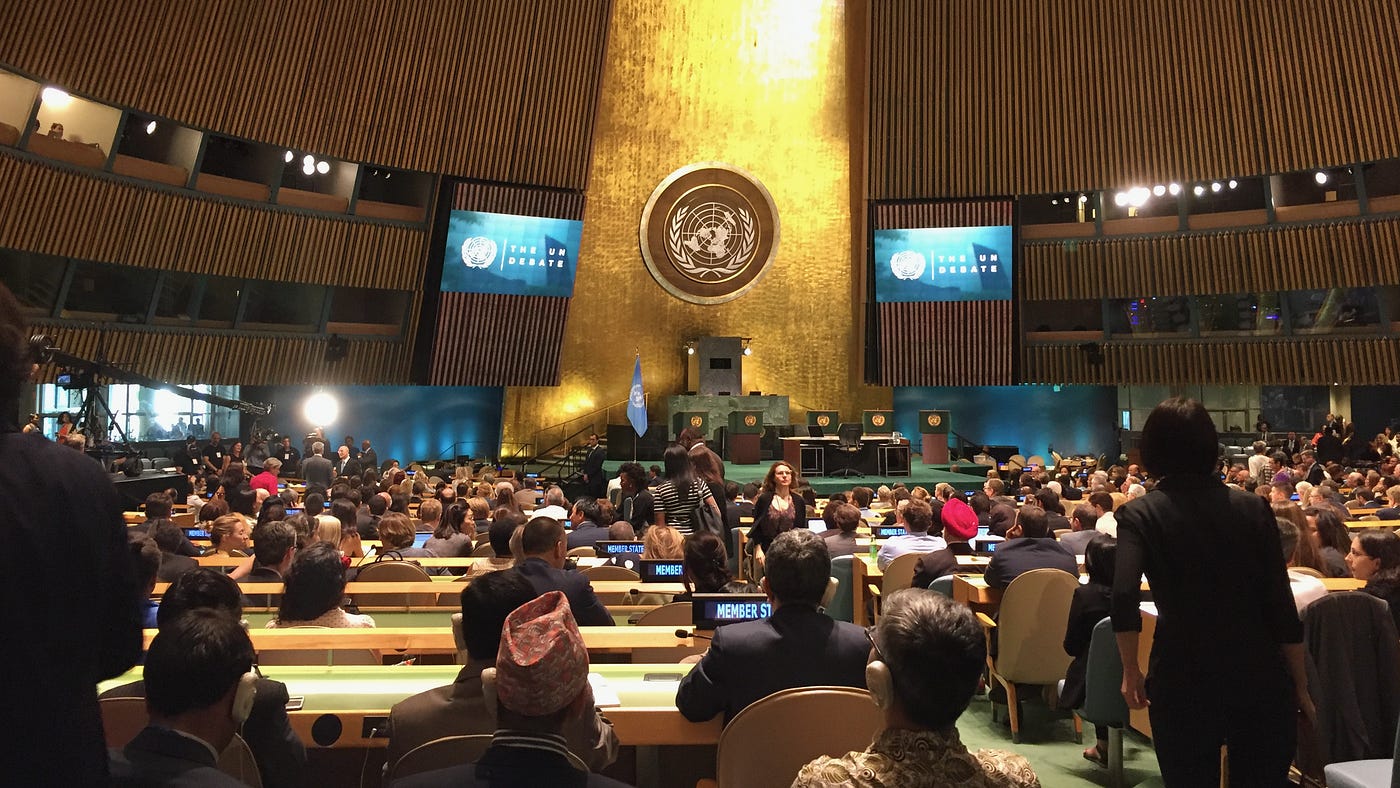
No nation can secure its citizens' rights, security, and opportunity on its own. Even a nation as large and wealthy as the United States accounts for only 4% of the global population. Deprivation and conflict are drivers of deep regional instability and lead to international security threats, including the destabilization of entire nations and regions.
The U.N. Charter opens with the words "We the Peoples" and commits:
"to save succeeding generations from the scourge of war";
"to reaffirm faith in fundamental human rights, in the dignity and worth of the human person, in the equal rights of men and women and of nations large and small";
"to establish conditions under which justice and respect for the obligations arising from treaties and other sources of international law can be maintained";
"to promote social progress and better standards of life in larger freedom";
"to ensure, by the acceptance of principles and the institution of methods, that armed force shall not be used, save in the common interest";
"to employ international machinery for the promotion of the economic and social advancement of all peoples".
As 1440 reports:
Since 1948, over 2 million peacekeepers from 125 countries have served in 71 missions. UN agencies have contributed to the eradication of smallpox in 1980 and the reduction of the under-five mortality rate by 52% since 2000.
Recent incursions by Russian drones and fighters into the airspace of at least three NATO countries and spillover from the Israel-Hamas conflict into neighboring countries threaten to create conditions in which the core principles of the Charter become inoperable and global war breaks out. Conflict is creating devastating conditions for civilians in Sudan, Gaza, Yemen, the Democratic Republic of Congo, and elsewhere, with potentially long-lasting destabilizing effects for the wider world.
Global health issues, including ripple effects of the COVID pandemic, worsening climate disruption, and trade-related policies that disrupt supply chains, are creating conditions of background scarcity and inaccessibility, which could undermine everyday economic activity in countries large and small. Post-COVID inflationary effects are still a serious area of macroeconomic and fiscal stability risk, affecting nearly all nations and driving decisions about energy production, technology development, financial regulation and transparency, and trade.
These threads of crisis come together to form what has become known—since the COVID-19 pandemic set in—as The Polycrisis. In our contribution to the Food Systems Summit +4 Stocktake in July, we outlined seven dimensions of polycrisis facing the community of nations in our time:
Climate disruption, nature loss and erosion of biodiversity and watersheds;
COVID-19 pandemic disruptions and after-effects, including inflation, income inequality, and financial instability;
Conflict, including serious impacts on food security;
Protectionist measures and related disruptions of trade and cooperation;
Income inequality worsening as a result of each of these and worsened by emerging generative AI technologies;
The "thorny problem" dynamic, where sensible solutions turn into unwanted ripple effects;
Fiscal stability stresses, where public budgets are overstretched and under-resourced, worsening shock events.
This layered landscape of polycrisis necessitates cross-cutting approaches, what the Paris Agreement describes as "integrated, holistic, and balanced" measures in which nations work together constructively to achieve added value through a range of co-benefits flowing from specific actions and investments.
Ten years ago this week, the U.N. General Assembly agreed 17 Sustainable Development Goals, a straightforward list of essential human aspirations that can improve lives through local, national, and coordinated international or multilateral action. Greatly misunderstood by some who cling to late 19th century geopolitical visions, centered on imperial "spheres", the SDGs are not a global regime but a common list of commitments by nations to honor the basic humanity of their own people, and to help each other do the same.
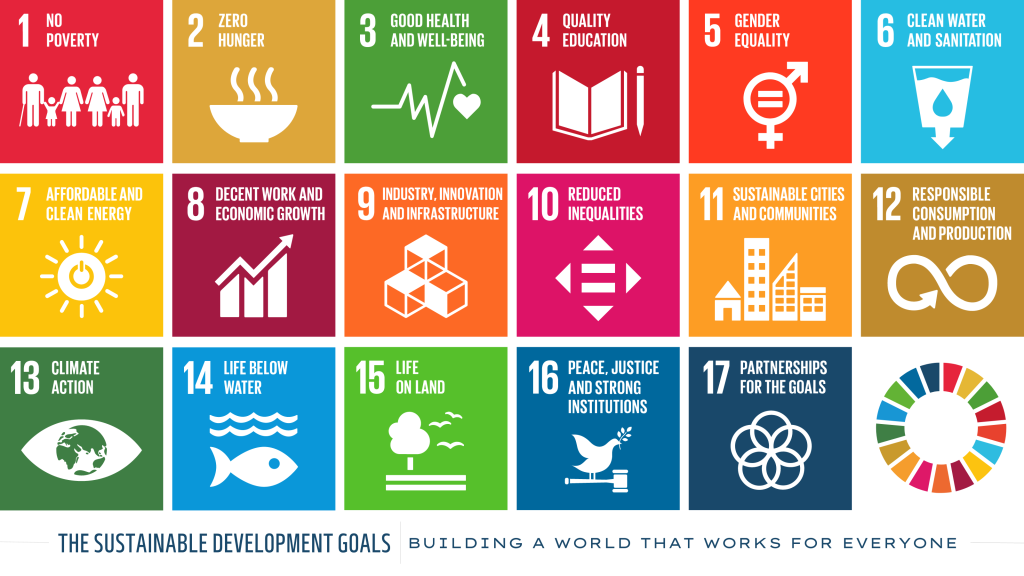
This distinction matters, because the most effective approach to SDG implementation is likely the ground-up locally rooted approach to solving problems for the benefit of people in communities, then coordinating successes to spread through national and international action. Cities and towns, counties and provincial governments, nations and international agencies, can all work together to reduce hunger and poverty, expand education and opportunity, protect the rights of women and girls, and build safe, clean societies with expanded, and sustainable opportunity.
As the WEAVE knowledge graphing experiment showed, interactions between areas of resilience knowledge can form intensely complex landscapes of risk and opportunity. Add just one dimension of your own personal preference to the 17 goals, and one more from your local community, and you can generate 121.6 quadrillion permutations—or recombinations of the underlying variables.
That 193 nations were able to agree 17 common goals was a tremendous achievement. 10 years later, all nations still need to find ways to advance across the goals, for the benefit of their own people and those of other nations. This is essential for avoiding the countless corrosive effects that can play out across more than 120 quadrillion potential areas of risk and cost.
We outline strategies for transformational and enduring local progress in the City Food Finance Principles to Build Climate Value, in our Capital to Communities update on Localizing Financial Innovation, in the Roadmap for Scaling Impact Investment in Urban Food Systems, and in our brief on Levers of Acceleration for Finance in Common. These local and multilevel cooperative approaches are critical for right-scaling solutions and creating a stable foundation for progress on the SDGs.
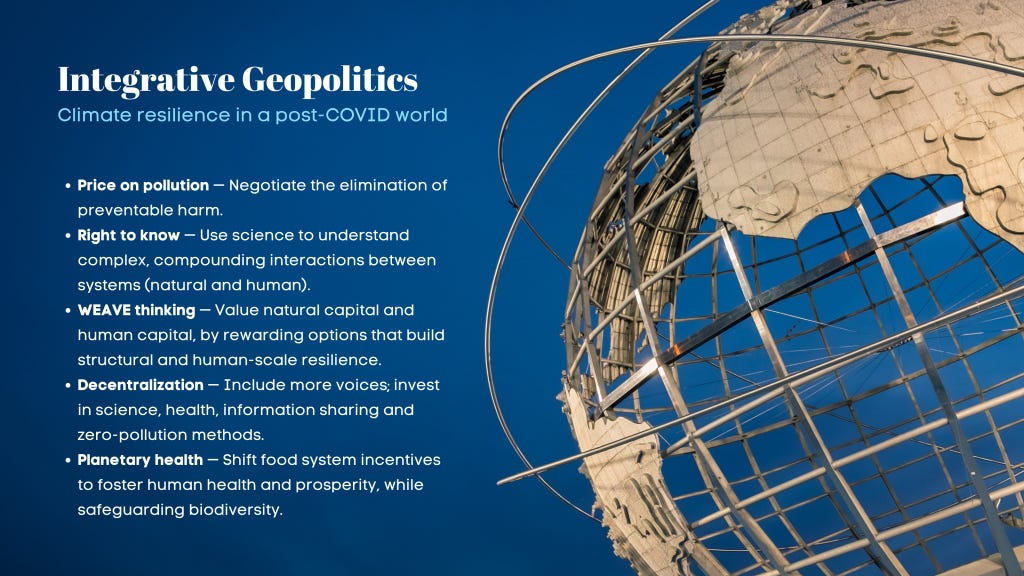
One of the most important breakthroughs in the development of international climate law happened in July, when the International Court of Justice ruled that nations have a legal duty to protect their peoples and those of other nations, as well as future generations, from the risk, harm, and cost of human-caused climate disruption. As we reported at the time:
it is necessary for states to conduct risk assessment, using the best available science, as part of their due diligence and harm prevention responsibilities. In other words, there is an implicit legal requirement for states to consider, maintain, improve, and utilize Earth observation science—to properly judge risk and not act from allegiance to specific commercial interests.
We support the need for active cooperation to align human industry and innovation with the health and resilience of nature, and we support the idea of an Earth System Assembly to improve the legal and structural capabilities of Member States to coordinate action that protects all nations from the devastating harm and cost of a degraded climate and biosphere.
While fiscal pressures and thorny problems tempt world leaders to pull back from shared commitments, doing so will only impose preventable and debilitating costs on their societies in the coming decades. We urge all Member States of the U.N. General Assembly to explore enhanced cooperative approaches to building healthy, liberated, resilient societies, and to engage at the 80th General Assembly with a vision for a future made far better, more secure, and prosperous for all, through good faith multilateral cooperation.
RELATED


